

How to Rethink Retail Media Analytics & Measurement (Without Breaking Everything)

Retail media has evolved in recent years from a performance channel into a core line item that touches each stage of the purchase funnel. With global retail media ad spend projected to hit nearly $197B in 2026, it’s no longer enough for marketers to measure efficiency alone. To justify the investment, brands and retailers need analytics that accurately show the impact of the spend. Better retail media analytics and measurement don’t require throwing out existing KPIs, but measuring what’s convenient doesn’t always equate to measuring what matters.
So what do better retail media KPIs actually look like in practice? You’ll want to start by rethinking a few core assumptions about how performance is measured.
Step 1: Get clear on ROAS
Understand what it can—and can’t—tell you
ROAS became the default retail media metric for a reason: it offered a simple, shared way to prove value in a channel that was still earning trust. Spend a dollar, generate attributed revenue, and report the return. This simplicity enabled retail media to scale quickly by aligning stakeholders, accelerating adoption, and giving teams a common language for performance.
ROAS was built for a moment when retail media needed a simple, shared way to show value. Today, as the channel matures, that simplicity can limit how well performance is understood.
Step 2: Separate efficiency from impact
Ask the incrementality question early
ROAS excels at measuring efficiency, but what it doesn’t do well is measure causality.
Attribution-based metrics reward proximity to purchase, not influence over behavior. When an ad appears close enough to a transaction (e.g. a shopper sees an ad for paintbrushes, an item they were about to put in their cart), the ad will receive credit for the purchase, regardless of whether it actually changed the outcome. Without this distinction, campaigns run the risk of looking successful on paper but failing to create new demand in reality.
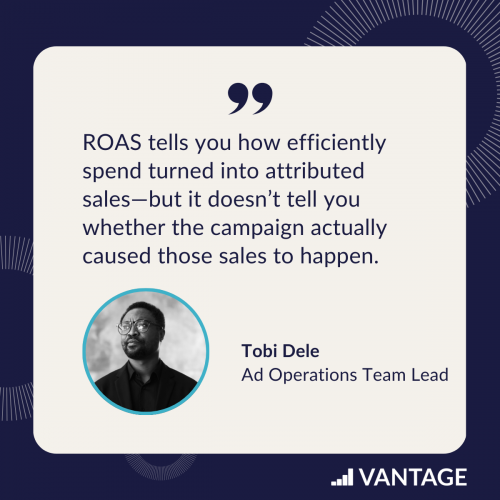
As Tobi Dele, Ad Operations Team Lead at Vantage, puts it: “ROAS tells you how efficiently spend turned into attributed sales, but it doesn’t tell you whether the campaign actually caused those sales to happen.” Reframing performance to understand whether media is driving true net-new outcomes (incremental buyers, incremental revenue, incremental trips) removes the ambiguity of wondering if an ad simply appeared at the right moment.
When asking for more budget, it becomes even more important to have accurate data that shows the value of upping your retail media investment.
This shift is no longer theoretical.
Retailers are being asked to defend premium pricing, and brands are being asked to justify expanding budgets, making retail media incrementality central to both of these conversations.
Step 3: Embrace transparency
Get honest about the tradeoffs
Measuring incremental impact isn’t easy—and that’s part of why progress has been slow. Some retailers are already experimenting with more rigorous incrementality measurement frameworks outside of traditional ecommerce environments. For example, Albertsons Media Collective recently rolled out a matched market incrementality approach for its in-store digital media network, comparing stores exposed to advertising against control stores to isolate true lift, rather than just attributing sales that might have happened anyway.
Marketing Mix Modeling has gained traction in recent years, but it can come with real constraints: long timelines, heavy data requirements, and high costs.
Getting internal alignment on the goal is just the first step; getting honest about the tradeoffs helps you identify potential blockers and manage expectations on timelines and execution.
Step 4: Start With the objective
Let the goal define the metric
ROAS excels at measuring efficiency, but what it doesn’t do well is measure causality.
One sign of progress is the industry’s growing willingness to rethink what success looks like in retail media measurement.
The Home Depot’s Orange Apron Media recently introduced Return on Marketing Objective (ROMO), a metric designed to gauge impact that extends beyond the immediate sales, tethering marketing efforts to long-term business goals. Taking the time to make measurement decisions driven by objectives moves you from a “one metric for all campaigns” mindset into “let’s measure what actually matters to us.”
Objective-led analytics create space for more nuanced measurement, without requiring perfect incrementality modeling on day one.
Step 5: Make progress without perfection
Evolve measurement over time
The next era of retail media analytics won’t arrive fully formed. It will be iterative, uneven, and occasionally uncomfortable.
You’ll know you’re moving in the right direction when you’ve come to a broad understanding of the metrics that matter most to your stakeholders and taken steps to help you track them in real time.
Why this matters:
ROAS helped retail media grow up. Now both retailers and brands need retail media measurement frameworks that can support long-term brand growth and incremental impact—even if new retail media KPIs are built while the industry is still in motion. We’ve outlined the key steps for you in a one-page framework designed to make those conversations easier.


About the Author: Bess Devenow

Bess Devenow is the Senior Strategic Insights & Communications Manager at Vantage, known for connecting dots across trends and telling clear, compelling stories that drive smarter decision-making.
With a background spanning market research, content strategy, and brand building, she thrives at the intersection of insight and narrative—making data not just understandable, but engaging.
When she’s not working, Bess is likely planning her next vacation, hiking, or scouting the best tiramisu in Los Angeles.
Sign up for Vantage Point
Vantage Point provides a monthly look at what’s shaping the future of retail media, from the lens of our experts.
One email per month. No noise. Just the ideas that matter.

The Operating System for Retail Media. Built for modern teams who demand unified operations and intelligent automation.


Get In Touch
🇨🇦 Canada:
🇺🇸 United States:
🇦🇺 Australia: